
Understand your fibromyalgia test result: WPI and SS
Understand WPI from 0–19 and SS from 0–12: pain areas, time frames, worked examples, and the limits of a fibromyalgia self-assessment.
- Author
- Frederik MarquartFounder & CEO, Elara Health
- Editorial responsibility
- Elara HealthPatient-centered health information
- Last updated
- September 26, 2026
What does my fibromyalgia test result mean?
Your result summarises your answers as two separate questionnaire values. It records the pain areas and symptoms you reported for the specified time frames.
WPI (0–19) counts the reported body areas that were painful during the past week.
SS, also called SSS (0–12), combines the severity of three core symptoms with the presence of three additional symptoms.
These values are neither percentages nor a probability of having fibromyalgia. An online result is not a diagnosis.
A fibromyalgia symptom check often gives you two numbers: WPI and SS. They describe different parts of your answers. This guide explains the calculations and helps you prepare questions for your clinician.
When reading your summary
Pain distribution and pain intensity are different measures.
Pay attention to the different time frames.
Read individual answers alongside the totals.
A low value does not automatically explain what causes your symptoms.
Record symptoms and understand your values
Prepare for your appointment with a free symptom check, an explanation of WPI and SS, and a printable answer summary.
WPI: which 19 pain areas are counted?
Each reported area contributes one point. Left and right count separately for paired areas. WPI describes distribution, not how intensely one area hurts.
Left and right: shoulder girdle, upper arm, lower arm, hip/buttock, upper leg, lower leg, and jaw (14 areas).
Also: neck, upper back, lower back, chest, and abdomen (5 areas).
SS: how is a value from 0 to 12 calculated?
The 2016 revision combines two parts. Fatigue, unrefreshing sleep, and cognitive symptoms during the past week each receive 0–3 points, giving up to 9 points.
Headache, lower abdominal pain or cramps, and depression during the past six months each contribute 0 or 1 point, giving up to 3 additional points. SS and SSS refer to the same Symptom Severity scale here.
A worked example without diagnostic classification
Suppose a person reports four painful areas: their WPI is 4 out of 19. Fatigue receives 2 points, unrefreshing sleep 1, and cognitive symptoms 1. This gives 4 out of 9 points.
If exactly one of the three additional symptoms is present, SS is 4 + 1 = 5 out of 12. WPI 4 and SS 5 are displayed separately. This fictional example explains only the arithmetic; it does not establish whether the person has fibromyalgia.
Why a total score is not a diagnosis
Clinical assessment also considers generalized pain distribution and symptom duration. Self-report cannot replace that assessment. The 2016 publication explicitly distinguishes physician assessment from the self-report version.
The number of WPI areas is not the same as the clinical distribution across five broader body regions. Other conditions can coexist. Discuss persistent symptoms with a clinician regardless of a supposedly “positive” or “negative” online result.
High and low values: what can they tell you?
A higher WPI comes from selecting more pain areas. A higher SS comes from rating the core symptoms more strongly and/or selecting more additional symptoms. The values alone do not explain the cause of symptoms or classify fibromyalgia as mild or severe.
Low values or zero points do not establish the absence of symptoms outside the questions and time frames covered. The self-assessment cannot confirm or exclude fibromyalgia or other conditions. Your specific symptoms, their course and their impact on daily life also matter in a medical conversation.
What to do with your summary
Elara’s symptom check provides your WPI/SS values and an overview of your answers. Add appointment notes on the result page, then open the print dialog. You can create a PDF file if your browser offers “Save as PDF” there. The website has no dedicated PDF export. Notes remain only in the open page; print or copy them before closing it.
When did symptoms start, and what has changed?
Which everyday activities have become harder?
Which medical reports, medications, and questions would you like to discuss?
More detail when you need it.
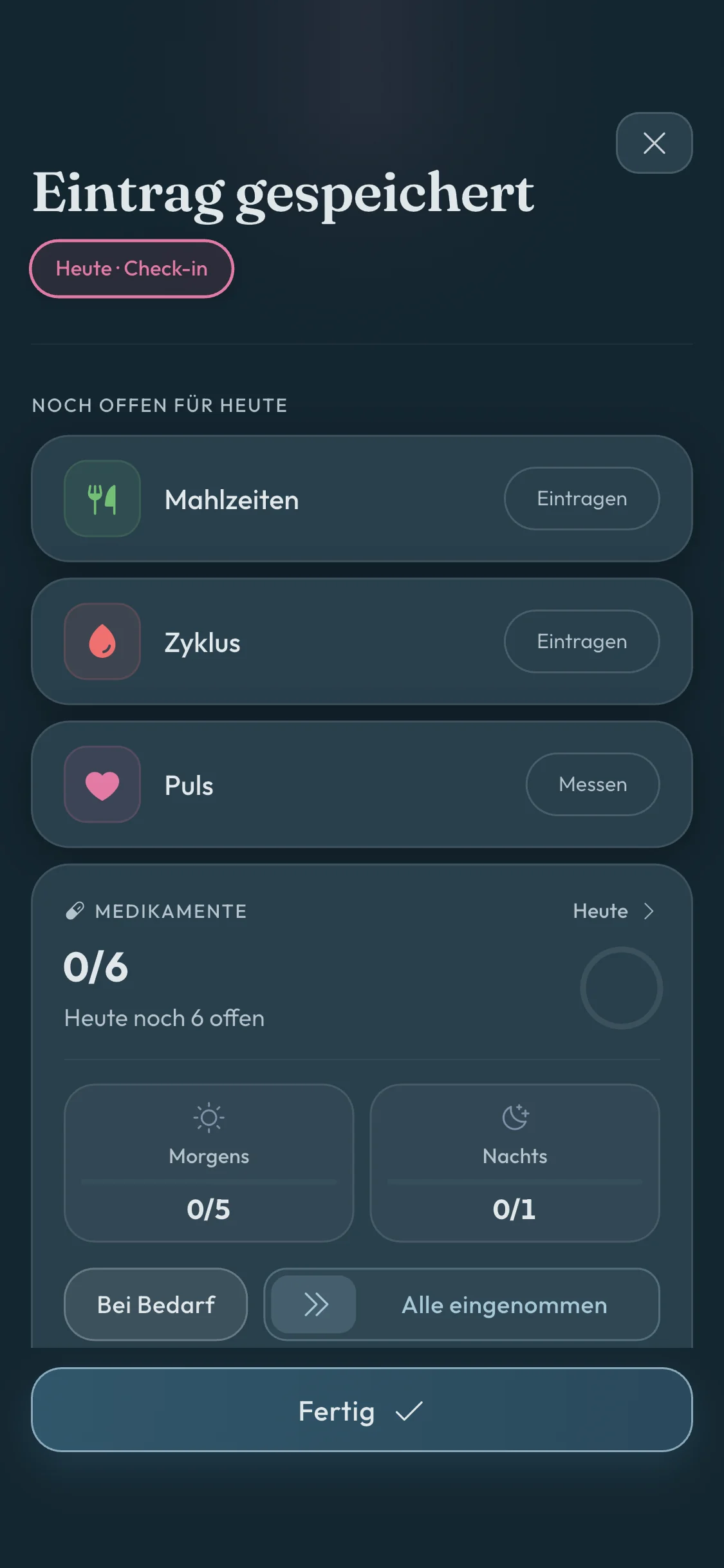
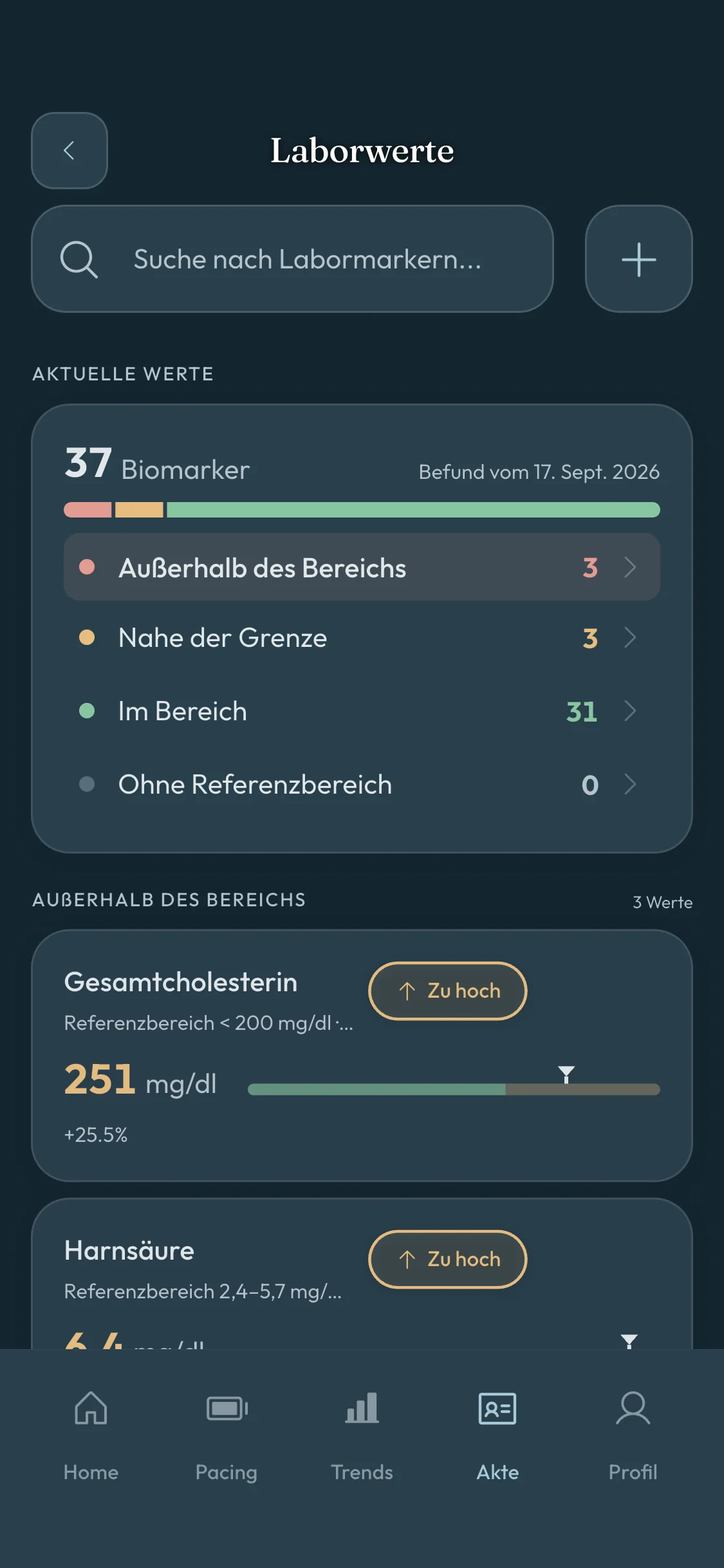
Medication and lab values can sit beside the rest of your history without crowding the pacing flow.
Common questions about WPI and SS
What does my fibromyalgia test result mean?
It is a structured summary of your answers: WPI counts painful body areas, while SS combines specific symptoms. Read both values alongside your individual answers and the time frames covered. The result neither confirms nor excludes fibromyalgia.
Does a high WPI or SS value mean I have fibromyalgia?
The values alone cannot establish that. A high WPI reflects many reported pain areas; a high SS reflects more or more strongly rated symptoms in the questionnaire. Elara does not derive a diagnosis or a probability of having fibromyalgia from these values.
Does a low value rule out fibromyalgia?
No. Low values describe your answers for the symptoms and time frames covered. They are not a rule-out test. If symptoms persist or affect your daily life, discuss them with a clinician regardless of the result.
Does WPI 10 mean a 10 percent chance of fibromyalgia?
No. WPI 10 means you reported pain in 10 of the 19 areas. It does not describe the probability of a condition.
Can two people have the same SS value but different symptoms?
Yes. Different individual answers can produce the same total. Bring the details about sleep, fatigue, and cognitive symptoms to your appointment too.
Can I compare my values over time?
You can look at dated summaries side by side. Consider the time frames and individual answers. A change alone does not establish a diagnosis or prove that a treatment works.
Guidelines and medical background
The linked guidelines and institutional resources explain the medical background. Editorial responsibility and any documented medical review are identified separately.
Editorial standards
- Medical background: 3 sources
- Educational context – not a substitute for medical diagnosis
- Links to related knowledge, questionnaires, and methodology
- NIAMS — Fibromyalgia: diagnosis and treatmentExternal source · Source: niams.nih.gov
- Wolfe et al. (2016): Revisions to the fibromyalgia diagnostic criteriaExternal source · Source: pubmed.ncbi.nlm.nih.gov
- Royal College of Physicians (2022): The diagnosis of fibromyalgia syndrome (PDF)External source · Source: rcp.ac.uk