Elara Logo
Elara-HealthYour pacing diary
Lab valueMetabolism

75g oGTT (kapilläres Vollblut)

General laboratory information. Elara does not automatically interpret this result as a diagnosis, cause, treatment target or activity limit.

Key takeaways

Read the result as a laboratory finding, not as a disease signal

75g oGTT (kapilläres Vollblut) should be read in the context of the actual test: why it was ordered, the specimen, method, unit, reference interval, and related findings. A laboratory value alone does not establish a diagnosis or cause.

Test context

When is 75g oGTT (kapilläres Vollblut) informative?

75g oGTT (kapilläres Vollblut) can be informative for the clinical question for which the test was ordered. Its meaning depends on the assay and surrounding findings rather than on the marker name alone.
Limits

What does 75g oGTT (kapilläres Vollblut) not establish on its own?

75g oGTT (kapilläres Vollblut) does not by itself diagnose an illness, identify the cause of symptoms, set a treatment target, or define a safe activity threshold.

Documentation

How can symptoms and lab results be kept in the same timeline safely?

Symptoms, function, and laboratory findings can be documented over the same period, but they remain separate pieces of information. Temporal overlap does not establish causation or disease-specific relevance.

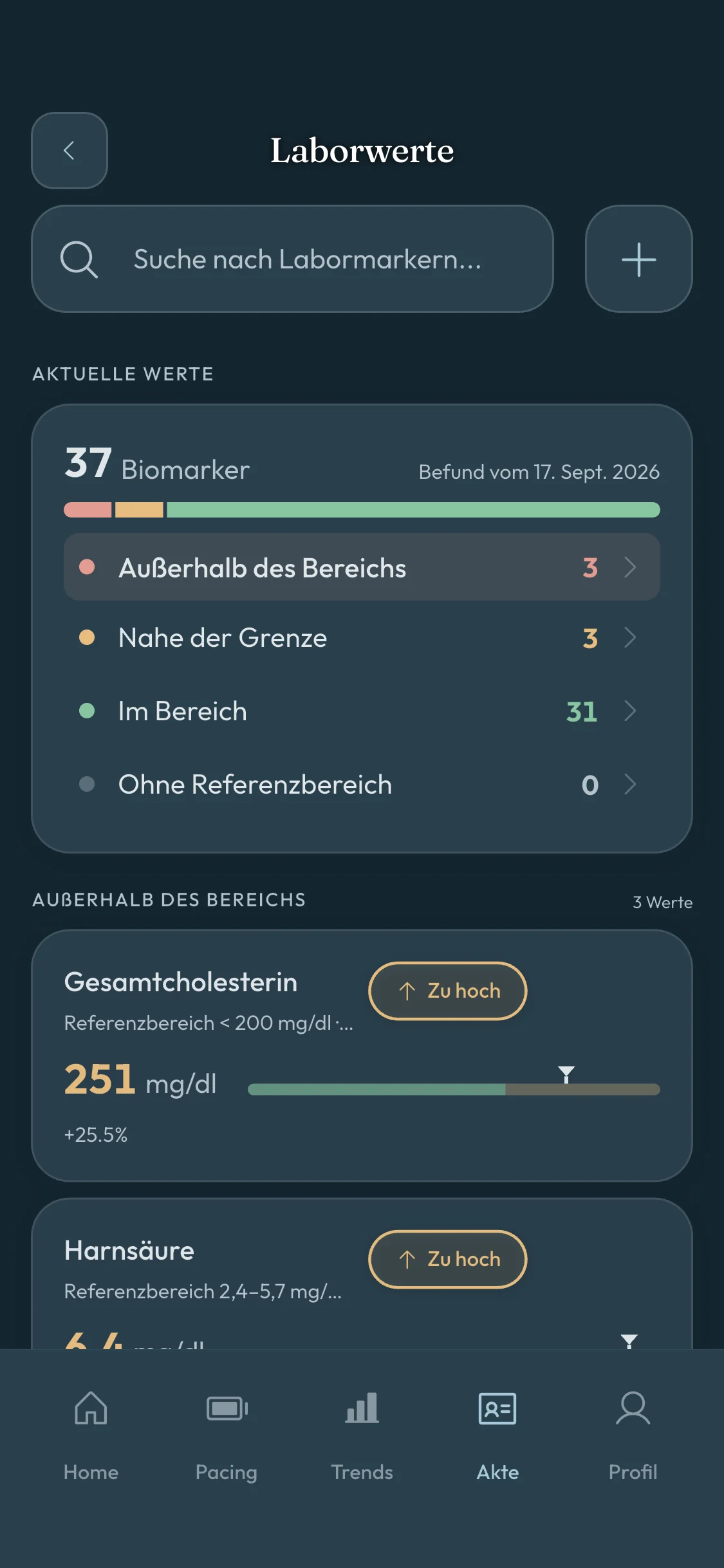
Elara lab values screen with reference ranges and current values, where 75g oGTT (kapilläres Vollblut) can be tracked too
Elara App

Keep 75g oGTT (kapilläres Vollblut) in view.

With Elara you can save the value, date and other entries in one timeline. The app does not automatically interpret a medical relationship between them.

  • Lab
  • Symptoms
  • Energy
  • Sleep
  • Notes
  1. 01

    Record the result

    Save the lab value with its date so individual measurements do not get lost.

  2. 02

    Review the trajectory

    See previous measurements together instead of relying on a single snapshot.

  3. 03

    View the same time period

    See 75g oGTT (kapilläres Vollblut) beside symptom, energy, sleep and other diary entries without treating timing as correlation or causation.

  4. 04

    Prepare the appointment

    Export your history as a PDF — structured for the next check-up.

Lab context

Related lab values

Related laboratory entries are shown for navigation only. They do not imply a diagnosis, causal relationship, or recommended follow-up test.

Knowledge

Keep 75g oGTT (kapilläres Vollblut) in laboratory context

A lab result is one piece of information. It does not automatically define a diagnosis, cause, treatment target, or activity limit.

  1. Return to the laboratory overview

    Compare related tests and categories without inferring a diagnosis or disease-specific meaning from this result. · Open lab markers

  2. Document symptoms separately

    Questionnaires can capture symptoms and function independently. A laboratory result does not establish their cause. · Open questionnaires

  3. Choose the clinical topic explicitly

    If the real question is about fatigue, ME/CFS, PEM, pacing, or another topic, choose that topic directly instead of deriving it from a lab value. · Open knowledge overview

About this page

Editorial & review

Updated
Medical review

No individual medical review is documented.

This English content was created with AI assistance and automatically validated. This is not an individual medical review.

Sources02

Literature & references

These references support the information presented on this page.

  1. 01

    https://www.ddg.info/fileadmin/user_upload/05_Behandlung/01_Leitlinien/Praxisempfehlungen/2025/dus_2025_S02_Praxisempfehlungen__online_only__Ausgabe-Online.pdf

    ddg.info

    Open
  2. 02

    https://www.niddk.nih.gov/health-information/diabetes/overview/tests-diagnosis

    niddk.nih.gov

    Open
Note:

This information does not replace medical advice. Lab values should be assessed in the context of your medical history, the reason for testing and other findings. Elara provides health information for orientation — not diagnoses or treatment decisions.