
When is LP-PLA2 informative?
LP-PLA2 can be informative for the clinical question for which the test was ordered. Its meaning depends on the assay and surrounding findings rather than on the marker name alone.
Lp-PLA2 is a lipoprotein-associated enzyme that may provide additional cardiovascular risk information. Assay type, unit and reference limits are method-specific, and the result is not a stand-alone treatment target.
General laboratory information only. Use the unit and reference interval on your own laboratory report; this page does not diagnose disease, determine a cause, or recommend treatment. If your laboratory flags a result as critical or you have severe acute symptoms, seek urgent medical care.
LP-PLA2 should be read in the context of the actual test: why it was ordered, the specimen, method, unit, reference interval, and related findings. A laboratory value alone does not establish a diagnosis or cause.
LP-PLA2 can be informative for the clinical question for which the test was ordered. Its meaning depends on the assay and surrounding findings rather than on the marker name alone.
LP-PLA2 does not by itself diagnose an illness, identify the cause of symptoms, set a treatment target, or define a safe activity threshold.
Symptoms, function, and laboratory findings can be documented over the same period, but they remain separate pieces of information. Temporal overlap does not establish causation or disease-specific relevance.
Lp-PLA2 is an enzyme that circulates mainly bound to lipoproteins. Depending on the laboratory, testing may measure enzyme activity or another assay-specific quantity, so units and reference limits are not interchangeable across test systems.
An Lp-PLA2 result can add information in selected cardiovascular-risk contexts, but it does not diagnose a specific vascular disease and should not determine treatment on its own. The 2026 AHA/ACC dyslipidemia guideline emphasizes overall risk assessment using PREVENT and selective risk refinement with measures such as coronary artery calcium, lipoprotein(a) and ApoB.
Elara therefore does not display a universal Lp-PLA2 target or use the result to recommend starting, stopping or intensifying treatment.
A low Lp-PLA2 result has no universal independent meaning without knowing the assay and the clinical question.
A higher Lp-PLA2 result may be associated with higher cardiovascular risk in some assay systems, but it does not diagnose a specific vascular disease and does not determine treatment by itself.
This result does not establish a diagnosis or the cause of symptoms by itself. Read it with the clinical question, related findings and the laboratory reference range rather than in isolation.
With Elara you can save the value, date and other entries in one timeline. The app does not automatically interpret a medical relationship between them.
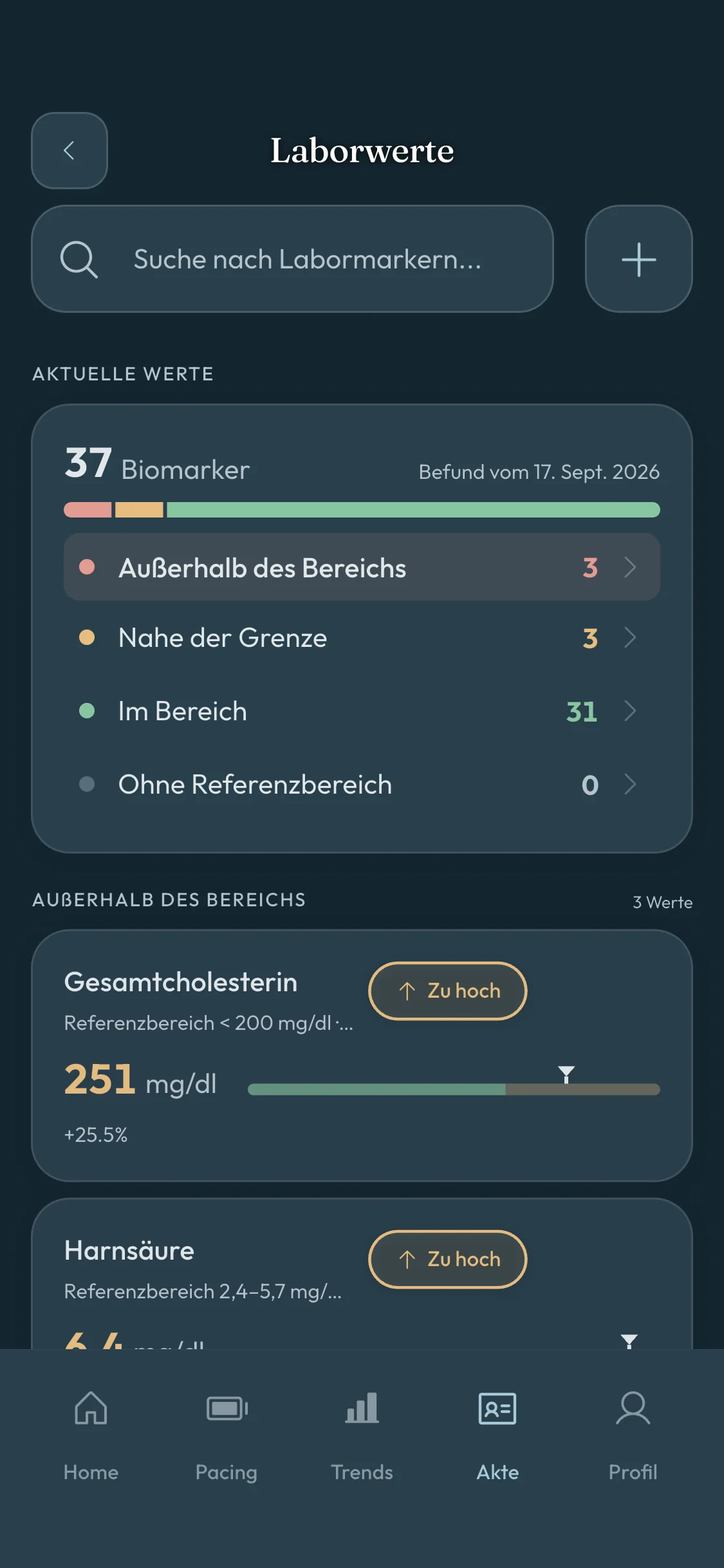
Save the lab value with its date so individual measurements do not get lost.
See previous measurements together instead of relying on a single snapshot.
See Lp-PLA2 (Lipoprotein-associated Phospholipase A2) beside symptom, energy, sleep and other diary entries without treating timing as correlation or causation.
Export your history as a PDF — structured for the next check-up.
Different assays can measure different quantities and use different units or reference limits. Use the method-specific information from the laboratory report.
No. It is at most one additional piece of risk information and should be considered within an overall cardiovascular risk assessment.
No. Lp-PLA2 is an enzyme associated with lipoproteins, while lipoprotein(a), or Lp(a), is a distinct lipoprotein particle and risk factor.
A lab result is one piece of information. It does not automatically define a diagnosis, cause, treatment target, or activity limit.
Compare related tests and categories without inferring a diagnosis or disease-specific meaning from this result.
Questionnaires can capture symptoms and function independently. A laboratory result does not establish their cause.
If the real question is about fatigue, ME/CFS, PEM, pacing, or another topic, choose that topic directly instead of deriving it from a lab value.
No individual medical review is documented.
These references support the information presented on this page.
This information does not replace medical advice. Lab values should be assessed in the context of your medical history, the reason for testing and other findings. Elara provides health information for orientation — not diagnoses or treatment decisions.