
PEM & wearables: heart rate, HRV, and the limits of pacing data
How heart-rate monitoring can support pacing, what HRV can add to longitudinal context, and why wearables cannot reliably predict a PEM crash.
Short answer
Wearables cannot reliably predict PEM. They can make exertion, heart rate, and recovery easier to view against your own baseline.
Heart-rate monitoring can provide biofeedback for pacing. If a ventilatory/anaerobic threshold (V/AT) has been professionally measured, its corresponding heart rate can provide an individual reference.
Without such measurement, there is no universal heart-rate formula that defines a safe PEM threshold.
HRV and resting heart rate can add context, but they should not be treated as stand-alone early warnings or a green light for the day.
PEM can appear with a delay after physical, cognitive, or emotional exertion. Wearables can make heart rate, activity, and recovery easier to document with little extra effort. They are not a PEM test or a reliable prediction system.
Key points
According to the CDC, PEM commonly worsens 12 to 48 hours after exertion; individual timing can vary.
Pacing means adapting activity and rest to individual limits, not following one universal number.
Heart-rate monitoring can provide biofeedback; an individually measured V/AT is more informative than generic age-based formulas.
HRV, resting heart rate, and activity are trajectory and context signals, not validated PEM predictors.
Editorial responsibility
Elara Health
Patient-centered health information
Last updated
September 14, 2026
Self-tests and pacing tools
PEM and pacing become more actionable when symptom burden and function are captured in a structured way.
ME/CFS symptom check
Useful when delayed worsening after activity raises the question of ME/CFS-oriented symptom structure.
FUNCAP-27 questionnaire
Best when daily limitation, recovery instability, and functional burden should be documented.
Compare pacing apps
Find out which apps offer symptom tracking, wearable integration, and pacing support.
Why wearables can still help with pacing
PEM does not always appear immediately after exertion. That makes it difficult to judge in the moment which demands may later be associated with worsening. Continuous or regular measurements can therefore be useful mainly as additional documentation.
The most useful signal is the personal trajectory: how do activity, heart rate, sleep, or resting heart rate change around better and worse days? These data can complement lived experience, not replace it.
Heart-rate monitoring as biofeedback
A heart-rate monitor can provide immediate biofeedback during physical or orthostatic demand. Workwell describes an approach in which, when a ventilatory/anaerobic threshold (V/AT) has been measured with appropriate CPET expertise, the corresponding heart rate can be used as an individual pacing reference.
That is different from predicting PEM: heart rate reflects current cardiovascular demand. Whether PEM develops later depends on many more factors, including physical, cognitive, and emotional exertion and the person’s current baseline.
Heart rate can make current physical demand visible.
A measured V/AT can provide an individual reference.
Cognitive and emotional demand are not fully represented by heart rate.
Symptoms and perceived exertion remain important additional signals.
Why there is no universal heart-rate ceiling
Generic formulas based on a fixed percentage of age-predicted maximum heart rate are not a reliable individual PEM threshold in ME/CFS. Workwell notes that altered heart-rate responses in ME/CFS can make standard age-based formulas a poor fit.
If heart rate is used for pacing, the number should therefore be treated as a personal reference rather than a medical clearance or a guarantee that staying below it will prevent a crash.
HRV and resting heart rate: context, not a crystal ball
HRV and resting heart rate respond to many influences, including sleep, infection, medication, hydration, stress, menstrual cycle, and measurement conditions. Changes may be interesting within a personal trajectory, but a single value is not specific to PEM.
Our longitudinal analyses so far support HRV and resting heart rate more as accompanying context signals. They do not currently provide a sufficiently robust stand-alone prediction of a later PEM episode.
Personal trends are more useful than universal normal values.
An unusual reading can have many causes.
HRV should not be treated as a diagnosis or a reliable traffic-light warning.
Comparing measurements with symptoms, exertion, and recovery remains central.
How Elara interprets wearable data today
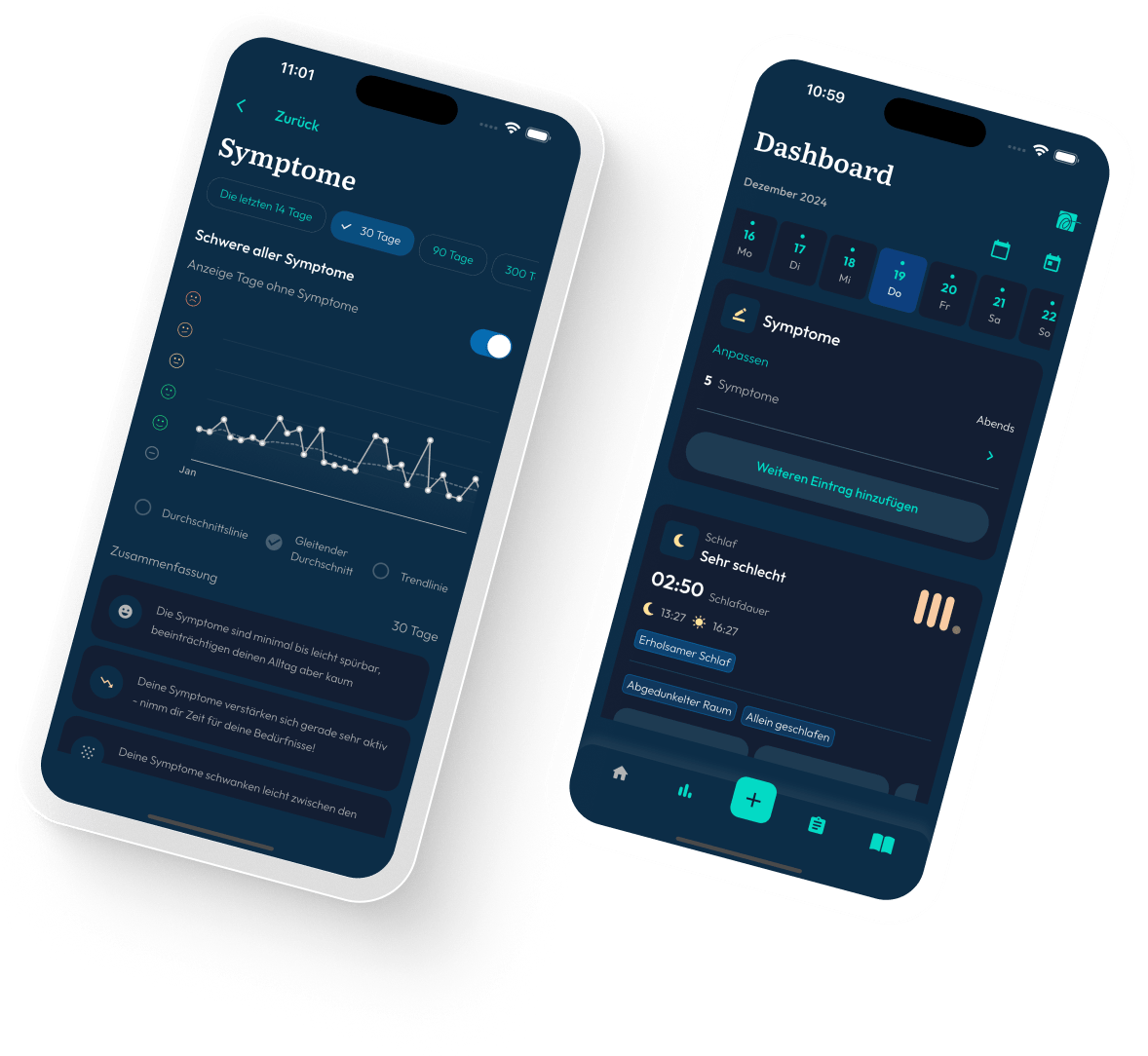
Elara brings wearable data and self-report onto one timeline. The goal is to make daily demand and longitudinal change easier to interpret against a personal baseline.
Elara currently does not provide a validated 24–72-hour PEM prediction. The app is intended to support documentation and pacing, not imply a medical forecast.
Limits and sensible use
Consumer wearables vary in accuracy across devices and situations and generally are not diagnostic medical devices for the pacing questions discussed here. Their data should add context rather than become the only basis for decisions.
For some severely affected people, wearing, checking, or interpreting a device can itself add burden. A useful system should reduce cognitive load rather than create a new set of obligations.
More context
More detail when you need it.
Medication and lab values can sit beside the rest of your history without crowding the pacing flow.
.png&w=1920&q=85)
.png&w=1920&q=85)
Document PEM patterns with the Elara app
Record symptoms, exertion, and recovery to better understand timing and recurring crash patterns in retrospect.
FAQ
Can a smartwatch predict a PEM crash?
Not reliably. Wearables can document exertion and recovery and add individual context, but there is currently no validated smartwatch metric that safely predicts a PEM crash.
What heart rate should I avoid exceeding with ME/CFS?
There is no universal number. If V/AT has been professionally measured, its corresponding heart rate can provide an individual pacing reference. Generic age-based formulas are much less certain.
What does HRV tell me about PEM?
HRV can add context about a personal recovery and exertion trajectory, but it is nonspecific and not a validated PEM predictor. It becomes more useful as a trend alongside symptoms and exertion.
Do wearable data replace a symptom diary?
No. Measurements and subjective reports complement each other. Cognitive, emotional, and sensory exertion in particular cannot be captured adequately by heart rate alone.
Editorial standards
The linked guidelines and institutional resources explain the medical background. Editorial responsibility and any documented medical review are identified separately.
Medical background: 5 sources
Educational context – not a substitute for medical diagnosis
Links to related knowledge, questionnaires, and methodology
Further reading
CDC – Managing ME/CFS and pacing
Open source
CDC – Strategies to prevent worsening of symptoms
Open source
Workwell Foundation – heart-rate monitoring and V/AT
Open source
HRV and PEM: current Elara evidence note
Open source
Energy Envelope whitepaper
Open source