
When is INR (Quick) informative?
INR (Quick) can be informative for the clinical question for which the test was ordered. Its meaning depends on the assay and surrounding findings rather than on the marker name alone.
INR standardizes prothrombin-time results across laboratories. A value near 1 is typical without vitamin K antagonist therapy, while anticoagulated patients may have a deliberately higher prescribed target range.
Significant bleeding while anticoagulated needs prompt medical help. Bleeding that will not stop, vomiting or coughing up blood, black or bloody stools, severe headache, fainting, marked weakness, or a head injury while taking a vitamin K antagonist need prompt medical assessment. Do not change the anticoagulant dose based on this page.
INR (Quick) should be read in the context of the actual test: why it was ordered, the specimen, method, unit, reference interval, and related findings. A laboratory value alone does not establish a diagnosis or cause.
INR (Quick) can be informative for the clinical question for which the test was ordered. Its meaning depends on the assay and surrounding findings rather than on the marker name alone.
INR (Quick) does not by itself diagnose an illness, identify the cause of symptoms, set a treatment target, or define a safe activity threshold.
Symptoms, function, and laboratory findings can be documented over the same period, but they remain separate pieces of information. Temporal overlap does not establish causation or disease-specific relevance.
The International Normalized Ratio (INR) is a standardized, dimensionless way of reporting prothrombin time. It is particularly used to monitor vitamin K antagonist anticoagulants such as warfarin or phenprocoumon.
For people who are not taking a vitamin K antagonist, INR is usually close to 1. During anticoagulant treatment, however, a higher range may be intentionally targeted. The therapeutic INR range depends on the clinical indication, which is why a single website target is inappropriate.
Elara therefore does not present one universal INR normal range. The laboratory report and, during anticoagulant therapy, the individually prescribed target range are what matter. Do not change an anticoagulant dose based on this page or an isolated result.
A lower INR means clotting is occurring faster relative to the standardized comparison. Without vitamin K antagonist therapy, a value near 1 can be expected. During treatment, the important question is whether the result is below the target range prescribed for that person.
A higher INR means clotting is taking longer. During vitamin K antagonist treatment, a higher INR can be intentional; what matters is whether the value is within the prescribed target range. An isolated result should not prompt self-directed medication changes.
This result does not establish a diagnosis or the cause of symptoms by itself. Read it with the clinical question, related findings and the laboratory reference range rather than in isolation.
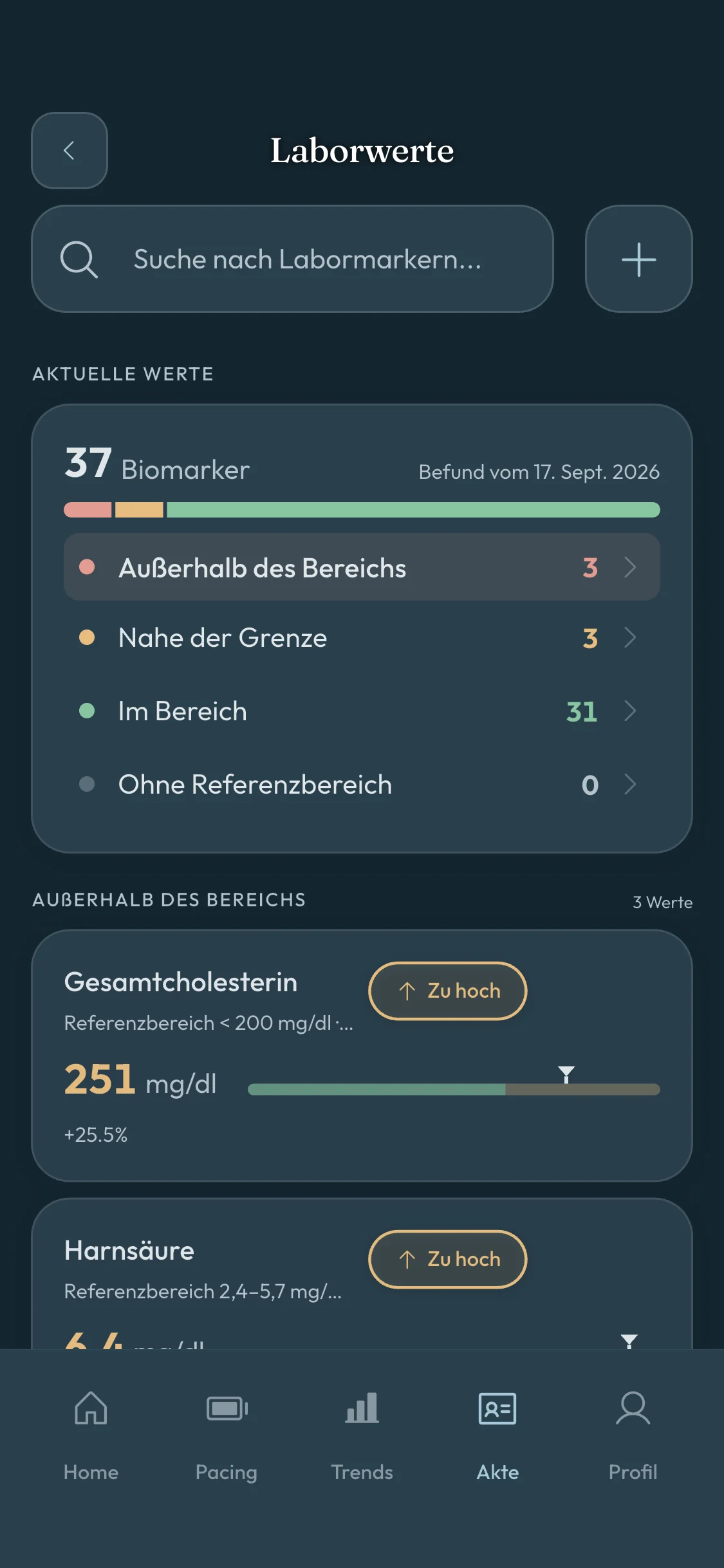
With Elara you can save the value, date and other entries in one timeline. The app does not automatically interpret a medical relationship between them.
Save the lab value with its date so individual measurements do not get lost.
See previous measurements together instead of relying on a single snapshot.
See INR (International Normalized Ratio) beside symptom, energy, sleep and other diary entries without treating timing as correlation or causation.
Export your history as a PDF — structured for the next check-up.
Because interpretation changes fundamentally when a person is taking a vitamin K antagonist. During treatment, the individually prescribed target range matters more than a generic website range.
No. INR is a standardized ratio and is dimensionless.
No. Dose changes should follow the individual treatment plan and clinical guidance, not general website information.
A lab result is one piece of information. It does not automatically define a diagnosis, cause, treatment target, or activity limit.
Compare related tests and categories without inferring a diagnosis or disease-specific meaning from this result. · Open lab markers
Questionnaires can capture symptoms and function independently. A laboratory result does not establish their cause. · Open questionnaires
If the real question is about fatigue, ME/CFS, PEM, pacing, or another topic, choose that topic directly instead of deriving it from a lab value. · Open knowledge overview
No individual medical review is documented.
These references support the information presented on this page.
This information does not replace medical advice. Lab values should be assessed in the context of your medical history, the reason for testing and other findings. Elara provides health information for orientation — not diagnoses or treatment decisions.